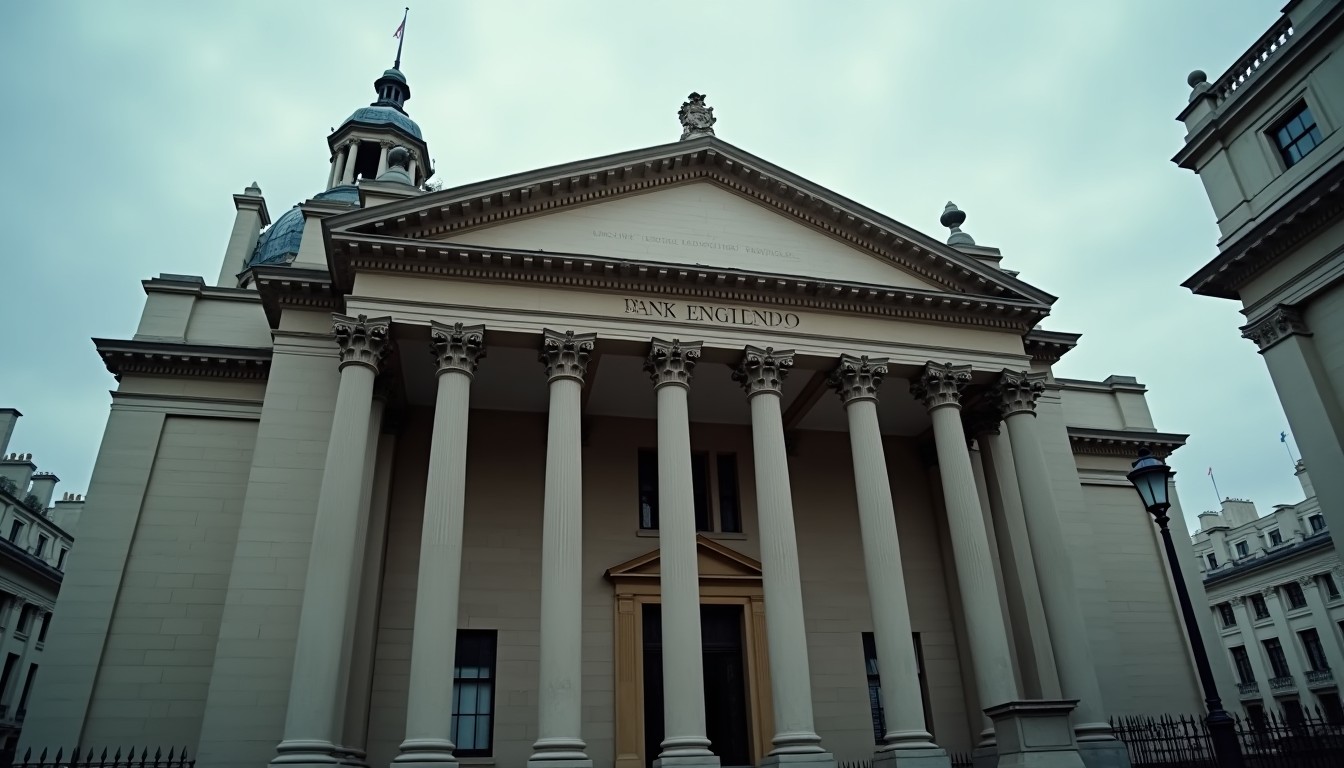
The History of Central Banking — Part 1: From the Bank of England to the Federal Reserve
Central banking evolved from early institutions like Sveriges Riksbank and Bank of England through financial crises of the 1800s, culminating in the Federal Reserve's creation in 1913 to provide monetary stability and prevent banking panics.
Key Takeaways
- →Central banks emerged to prevent banking panics and provide monetary stability, directly affecting interest rates and investment returns globally.
- →The Federal Reserve's 1913 creation established modern central banking principles that still influence Australian market conditions through currency flows.
- →Historical banking crises led to lender-of-last-resort functions, creating government backstops that reduce but don't eliminate systemic financial risks.
- →Early central banks like Bank of England demonstrated how monetary policy affects asset prices, inflation, and currency values across international markets.
- →Understanding central bank evolution helps investors anticipate policy responses during financial stress and position portfolios accordingly for protection.
Bank of England Founded
1694 — created to fund King William III's war against France
First Central Bank
Sveriges Riksbank, Sweden 1668 — oldest central bank still in operation
Federal Reserve Created
December 23 1913 — signed into law by President Woodrow Wilson
Jekyll Island Meeting
November 1910 — secret meeting of bankers that drafted the Federal Reserve Act
Bagehot's Rule
1873 — lend freely at penalty rates against good collateral during a crisis
Bank of England Nationalised
1946 — brought under public ownership by the Attlee government
The evolution of central banking represents one of the most profound institutional developments in modern economic history. Over three and half centuries, the world's monetary systems have transformed from fragmented networks of private banks vulnerable to cascading failures, to sophisticated central banking architectures capable of stabilising entire national economies. This transformation began with the establishment of Sveriges Riksbank in 1668 and the Bank of England in 1694, institutions born from the practical necessity of financing wars and managing government debt, yet which evolved into the monetary guardians of their respective nations.
The path from these early experiments to the creation of the Federal Reserve in 1913 reveals the persistent tension between public monetary authority and private financial power that continues to shape central banking today. Each financial crisis — from the South Sea Bubble of 1720 to the Panic of 1907 — forced governments to grapple with fundamental questions about who should control money supply, how to prevent bank runs, and whether central banking represented essential financial infrastructure or dangerous concentration of power.
The American experience proved particularly instructive, as the young republic's ideological resistance to central banking led to repeated financial catastrophes that ultimately compelled the adoption of the Federal Reserve System.
Key Historical Facts
Why Central Banks Exist
Before the advent of central banking, financial systems operated as loose confederations of private banks with no coordinating authority during times of crisis. Bank runs represented an existential threat to individual institutions and the broader economy. When depositors lost confidence in a bank's solvency, they would rush to withdraw their funds simultaneously. Since banks operated on fractional reserves — lending out most deposits while keeping only a small portion in cash — they could not satisfy all withdrawal demands at once.
This created a self-fulfilling prophecy where fear of insolvency caused actual insolvency, often spreading to healthy banks through contagion effects.
The concept of a "lender of last resort" emerged as the theoretical solution to this problem. A central bank, with its ability to create money, could provide emergency liquidity to solvent but illiquid banks during a panic. The intellectual foundation for this approach was laid by Walter Bagehot in his 1873 masterwork Lombard Street: A Description of the Money Market, which remains the definitive text on central bank crisis management.
"To avert a panic, central banks should lend freely, boldly, and readily, at a rate of interest higher than the market rate in normal times, against any sort of current security which in ordinary times is reckoned a good security." — Walter Bagehot, Lombard Street (1873)
Bagehot's rule addressed three critical elements of crisis response: unlimited lending prevented bank failures due to illiquidity, penalty interest rates discouraged moral hazard by making central bank funding expensive, and good collateral requirements protected the central bank from losses while ensuring that only temporarily illiquid institutions received support.
Private banks proved incapable of self-regulation during crises because their interests diverged from broader economic stability. During a panic, each bank's rational response was to hoard cash and call in loans to preserve its own liquidity, but this collective behaviour deepened the crisis by contracting credit throughout the economy. Only an institution with the power to create money — and a mandate to prioritise systemic stability over private profit — could break this destructive cycle.
The political dimension of central banking emerged from the recognition that monetary policy represented sovereign power. Control over money supply affected inflation, employment, and the distribution of wealth throughout society. This created ongoing tension between democratic accountability and technical expertise, between public oversight and operational independence — tensions that continue to shape central banking debates today.
The Sveriges Riksbank and Early Experiments
The world's first central bank emerged from financial catastrophe in 17th-century Sweden. The Bank of Stockholm, established in 1657 by Johan Palmstruch, initially succeeded by issuing Europe's first paper banknotes as receipts for deposited coins. However, Palmstruch succumbed to the eternal temptation of money creation, issuing far more notes than he could redeem with the coins in his vaults. When depositors inevitably demanded redemption, the bank collapsed in 1668.
From this failure arose Sveriges Riksbank, chartered by the Swedish Parliament (Riksdag) in 1668 as a state-owned institution. The Riksbank learned crucial lessons from its predecessor's demise, establishing more conservative reserve ratios and parliamentary oversight of note issuance. These early experiences revealed the fundamental challenge of paper money: maintaining public confidence in the convertibility of notes into precious metals.
Over the following decades, the Riksbank evolved from a simple lending institution into Sweden's monetary authority. It developed many practices that would become standard central banking functions: serving as the government's banker, managing the national debt, and gradually asserting control over the money supply. The Riksbank's survival for over 350 years demonstrated that central banks required both technical competence and political legitimacy to function effectively.
The Bank of England
The Bank of England's founding in 1694 represented a watershed moment in financial history. King William III faced the enormous expense of fighting the Nine Years' War against France, but Parliament would not approve sufficient taxes to fund the conflict. The solution emerged from a proposal by William Paterson: a group of private investors would lend £1.2 million to the government at 8% interest annually, receiving in return a royal charter establishing the Bank of England with a monopoly on note issuance in England.
This original bargain revealed the symbiotic relationship between sovereign power and private capital that characterised early central banking. The government received immediate war financing, while the Bank's shareholders gained exclusive rights to profit from money creation. The arrangement proved so successful that it was repeatedly renewed, with the Bank becoming the permanent fiscal agent of the British government.
The Bank's first major crisis came with the South Sea Bubble of 1720, when speculation in South Sea Company shares created a massive financial bubble. When the bubble burst, panic gripped London's financial markets.
"The Bank of England's decisive action during the South Sea crisis established the precedent that central banks must act as lenders of last resort during financial panics, even when the crisis originates from speculation rather than fundamental economic weakness." — Economic historian Charles Kindleberger
The Bank's intervention, providing liquidity to solvent institutions while allowing speculative ventures to fail, helped stabilise the financial system and established principles that would guide central banking for centuries. For analysis of the financial panics and crises that shaped central banking, see Bubblepedia →
The Bank Charter Act of 1844 marked another crucial development, formally separating the Bank's Issue Department (responsible for note issuance) from its Banking Department (conducting commercial operations). This separation aimed to prevent the Bank from expanding the money supply for commercial advantage while ensuring adequate backing for banknotes.
The Bank of England served as the template for central banks worldwide, with its combination of government charter, note-issuing monopoly, and role as lender of last resort being copied from Russia to Japan. The Bank's nationalisation in 1946 by the Attlee government reflected the post-war consensus that monetary policy was too important to remain in private hands, though the Bank retained operational independence in conducting day-to-day monetary operations.
The National Banking Era in America
The United States approached central banking with profound ambivalence rooted in Jeffersonian suspicions of concentrated financial power. Thomas Jefferson and his followers viewed central banks as instruments of aristocratic privilege that concentrated economic power in the hands of urban financiers at the expense of farmers and small merchants. This ideological opposition shaped American monetary history for over a century.
Alexander Hamilton succeeded in establishing the First Bank of the United States in 1791, modelled on the Bank of England. The Bank served as the federal government's fiscal agent, maintained a uniform national currency, and provided some degree of monetary coordination. However, when its charter came up for renewal in 1811, Congress refused to extend it by a single vote, reflecting continued suspicion of central banking power.
The Second Bank of the United States, chartered in 1816 following the financial chaos of the War of 1812, met an even more dramatic fate. Under the leadership of Nicholas Biddle, the Bank became increasingly powerful and politically controversial. President Andrew Jackson viewed it as a corrupt monopoly that concentrated economic power among Eastern elites.
"The Bank is trying to kill me, but I will kill it!" Jackson declared during his successful campaign to destroy the Second Bank. His 1832 veto message denounced the Bank as a vehicle through which "the rich and powerful too often bend the acts of government to their selfish purposes."
Jackson's destruction of the Second Bank in 1836 ushered in the "Free Banking Era," characterised by decentralised state-chartered banks with no coordinating monetary authority. The National Banking Act of 1863 brought some order to this system by creating nationally chartered banks and establishing a uniform currency, but it could not prevent recurring financial panics.
The Panics of 1873, 1893, and 1907 demonstrated the costs of operating without a central bank. Each crisis followed a similar pattern: initial financial shock, bank runs, credit contraction, and economic depression lasting several years. The absence of a lender of last resort meant that illiquid but solvent banks failed alongside genuinely insolvent institutions, amplifying economic damage far beyond what fundamental conditions warranted.
The Panic of 1907 and JP Morgan
The Panic of 1907 began with speculation in copper mining stocks by F. Augustus Heinze and his associates. When their corner on United Copper Company shares failed in October 1907, it triggered runs on banks connected to the speculators. The crisis quickly spread throughout New York's financial system as depositors lost confidence in multiple institutions.
In the absence of a central bank, J.P. Morgan personally organised the financial system's rescue. Operating from his Madison Avenue library, the 70-year-old financier assembled meetings of bank presidents, allocated emergency funding, and personally guaranteed the solvency of key institutions. Morgan's intervention stabilised the panic, but at tremendous cost to his personal fortune and health.
The spectacle of America's financial system depending on a single private individual for salvation proved politically unacceptable to both progressives and conservatives. The Pujo Committee's subsequent investigation revealed the extent of Morgan's influence over American banking, documenting what critics called the "money trust." Progressive reformers argued that such concentrated private power was incompatible with democratic governance, while conservative financiers recognised that relying on one man's resources was unsustainable.
The Aldrich-Vreeland Act of 1908 provided a temporary response, authorising emergency currency issuance during panics, but policymakers recognised that America needed a permanent solution to its recurring financial crises.
The Jekyll Island Meeting
In November 1910, a small group of America's most powerful financiers met in secret at Jekyll Island, Georgia, to draft legislation creating a central bank. The gathering included Senator Nelson Aldrich (chairman of the Senate Finance Committee), Paul Warburg (partner at Kuhn, Loeb & Co.), Frank Vanderlip (president of National City Bank), and other Wall Street leaders.
The meeting's secrecy reflected the political sensitivity surrounding central banking. Any plan obviously originating from Wall Street would face immediate populist opposition, while the participants needed to freely discuss technical details without political constraints. The group spent ten days crafting what became the foundation for the Federal Reserve Act.
Progressive opposition remained fierce despite efforts to disguise the plan's Wall Street origins. William Jennings Bryan and other Democratic leaders attacked the proposal as a banker's conspiracy to consolidate control over the nation's money supply. Rural congressmen feared that a central bank would favour Eastern commercial interests over agricultural credit needs.
The final compromise, signed into law by President Woodrow Wilson on December 23, 1913, reflected these political tensions. Rather than a single central bank, the Federal Reserve System consisted of twelve regional Reserve Banks supervised by a Board of Governors in Washington. This structure aimed to balance Wall Street expertise with democratic accountability and regional representation.
| Institution | Years | Structure | Fate |
|---|---|---|---|
| First Bank of the US | 1791-1811 | Single national bank, 20% government ownership | Charter not renewed |
| Second Bank of the US | 1816-1836 | Single national bank, 20% government ownership | Destroyed by Andrew Jackson |
| National Banking System | 1863-1913 | Multiple national banks, no central coordination | Replaced by Federal Reserve |
| Federal Reserve System | 1913-present | 12 regional banks, central Board of Governors | Still operating |
The Federal Reserve's Early Structure
The Federal Reserve's unique architecture reflected American ambivalence about central banking power. The twelve regional Federal Reserve Banks — located in cities from Boston to San Francisco — represented a compromise between Wall Street's preference for centralised efficiency and rural America's suspicion of concentrated financial power. Each regional bank served its local district while participating in national monetary policy through the Federal Open Market Committee.
The Board of Governors in Washington provided political oversight and coordination, with members appointed by the President and confirmed by the Senate for fourteen-year terms. This structure aimed to insulate monetary policy from short-term political pressures while maintaining democratic accountability through the appointment process.
Despite this careful design, the Federal Reserve's early performance proved deeply disappointing. During the Great Depression from 1929 to 1933, the Fed allowed approximately one-third of American banks to fail, transforming what could have been a severe but manageable recession into the worst economic catastrophe in modern history. Milton Friedman's definitive analysis in A Monetary History of the United States demonstrated that the Fed's failure to provide adequate liquidity during bank runs violated the fundamental principles of central banking established by Walter Bagehot sixty years earlier.
"Let me end my talk by abusing slightly my status as an official representative of the Federal Reserve. I would like to say to Milton and Anna: Regarding the Great Depression, you're right, we did it. We're very sorry. But thanks to you, we won't do it again." — Ben Bernanke, Federal Reserve Chairman, 2002
This acknowledgment of failure led to fundamental reforms in central banking doctrine and practice that would reshape monetary policy in the 20th century. The evolution of these new approaches, from the abandonment of the gold standard to the development of modern inflation targeting, forms the subject of our examination of central banking's modern era. The Federal Reserve's transformation from a passive guardian of gold convertibility to an active manager of economic cycles represents one of the most significant institutional developments in modern economic history, built upon the foundations established during these formative centuries of central banking evolution.
Understanding this historical foundation proves essential for modern investors, as the evolution of money itself remains inextricably linked to central banking development, with profound implications for asset allocation, inflation protection, and long-term wealth preservation strategies in today's monetary environment.
Frequently Asked Questions
What is central banking and how does it work in Australia?
Central banking involves a nation's primary monetary authority controlling money supply and interest rates. In Australia, the Reserve Bank of Australia (RBA) serves as our central bank, setting the official cash rate, regulating financial institutions, and managing currency. The RBA's decisions directly impact mortgage rates, savings accounts, and ASX-listed companies' borrowing costs.
How does the RBA's history compare to other central banks like the Federal Reserve?
The RBA was established in 1960, much later than the Federal Reserve (1913) or Bank of England (1694). Australia initially relied on the Commonwealth Bank for central banking functions from 1911. Like other central banks, the RBA evolved from financial crises, particularly the 1890s depression and post-WWII economic challenges requiring independent monetary policy.
What are the main risks of central banking decisions for Australian investors?
Central banking decisions create inflation risk, interest rate risk, and currency volatility. When the RBA raises rates, ASX growth stocks often fall while bank shares may rise. Rapid monetary policy changes can trigger market corrections, affect property values, and impact dividend yields across sectors, particularly REITs and utilities.
How can Australian investors practically use RBA policy changes in their investment strategy?
Monitor RBA meeting minutes and cash rate decisions to anticipate sector rotations. Rising rates typically benefit banks (CBA, ANZ, WBC, NAB) while pressuring growth stocks and REITs. Consider bond duration and dividend-paying stocks' sustainability. Use RBA forward guidance to time entries into interest-sensitive sectors and adjust portfolio allocation accordingly.
Recommended Reading

Key Statistics
Bank of England Founded
1694 — created to fund King William III's war against France
First Central Bank
Sveriges Riksbank, Sweden 1668 — oldest central bank still in operation
Federal Reserve Created
December 23 1913 — signed into law by President Woodrow Wilson
Jekyll Island Meeting
November 1910 — secret meeting of bankers that drafted the Federal Reserve Act
Bagehot's Rule
1873 — lend freely at penalty rates against good collateral during a crisis
Bank of England Nationalised
1946 — brought under public ownership by the Attlee government