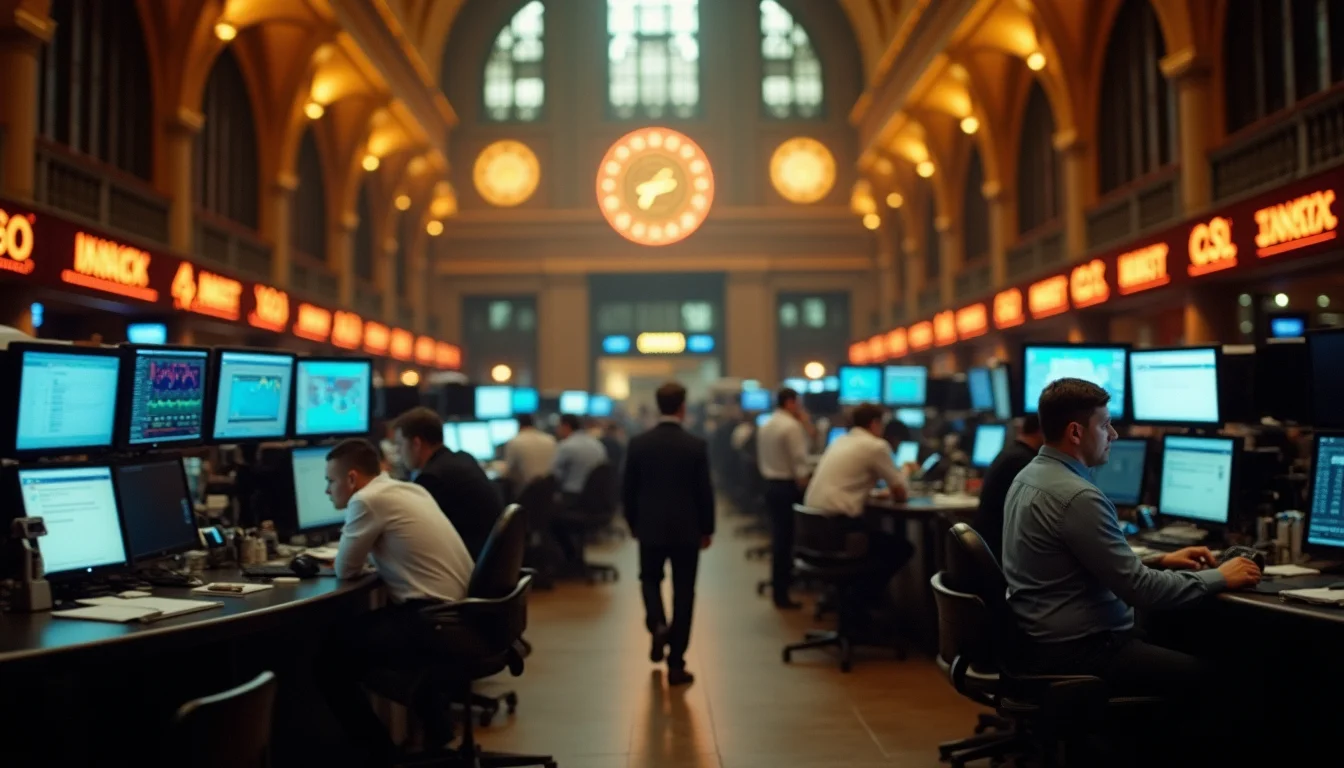
According to The New York Times stocks across Asia tumbled as uncertainty over artificial intelligence valuations and earnings delivery jolted technology shares, sending the Nikkei 225 down 4.15% to 69,361 and the Hang Seng lower by 1.92% to 22,633. The Shanghai Composite fell 1.76% to 4,038, completing a broad regional retreat that stands in sharp contrast to gains in European markets, where the DAX rose 1.03% to 24,995 and the Euro Stoxx 50 added 0.85% to 6,268.
AI Valuation Concerns Drive the Asian Selloff
The sharp declines across Asian technology-heavy indices reflect a question that has been building for months: whether the earnings growth from artificial intelligence can justify the valuations markets have assigned to companies in the sector. The Shiller CAPE ratio for US equities sits at 41.0 — a level that has historically preceded extended periods of compressed returns. When growth expectations for the dominant theme driving that premium come into question, the correction can be swift.
The selloff in Asian markets, while affecting the Nikkei 225 and its semiconductor and electronic component manufacturers, reportedly originated in South Korea, where regulatory concerns over leveraged ETFs linked to the Korean index — dominated by semiconductor giants Samsung and SK Hynix — triggered overseas profit-taking that spread across the region. the global AI trade, with semiconductor and electronic component manufacturers forming a significant weight in the index. A 4.15% single-session decline of this magnitude reveals how much speculative premium had accumulated. The VIX rose 1.4% to 18.89, signalling that hedging demand is picking up even as US benchmarks held near flat — the S&P 500 closed at 7,357, down just 0.01%, while the NASDAQ 100 managed a 0.75% gain to 29,440.
East-West Divergence Points to Active Sector Rotation
The simultaneous decline in Asian indices and advance in European ones is not noise — it reflects a deliberate capital reallocation. European markets carry a different sectoral composition than Asian bourses: heavier in industrials, financials, and energy; lighter in pure-play technology. As confidence in AI-driven earnings stalls, capital is rotating toward sectors with more visible near-term cash flows and less demanding valuation multiples. The DAX at 24,995 and the CAC 40 at 8,432 (up 0.55%) both reflect this preference shift.
The sector rotation playing out across global markets also shows up in commodity pricing. Copper fell 1.05% to $6.07 per pound, consistent with reduced optimism around the industrial capex cycle that AI infrastructure spending was expected to accelerate. WTI crude dropped 1.85% to $70.59 per barrel, adding another layer of caution around global demand. Meanwhile, gold climbed 1.06% to $4,026 per ounce, confirming the defensive tilt by risk-averse capital. For a historical perspective on how commodity cycles and equity valuations have interacted during prior speculative peaks, Bubblepedia's analysis of historical market bubbles offers useful context on where current conditions sit relative to past inflection points.
US Markets Absorb the Shock — For Now
The relative resilience of US benchmarks on the same session is notable. The Dow added 0.14% to 51,921, the Russell 2000 gained 0.71% to 3,008, and the NASDAQ 100 rose modestly. This apparent stability deserves scrutiny rather than comfort. The Russell 2000's outperformance relative to large-cap tech is itself a rotation signal — investors shifting within the US market from mega-cap AI beneficiaries toward domestically-oriented small-caps with less exposure to global technology earnings risk.
The US 10-year yield at 4.50% remains well above the Fed Funds rate of 3.63%, a spread that continues to pressure equity valuations by raising the discount rate applied to long-duration assets — precisely the category that high-multiple technology stocks occupy. The technical structure of major indices warrants close attention here: a session where Asian markets sell off sharply while US markets hold is often a leading indicator rather than a divergence that persists. Understanding these dynamics is covered in depth in The History of Stock Markets — Part 3: The GFC, the Decade of QE, and the Modern Market which traces how quantitative easing created the conditions for today's AI-driven bull market and the valuation risks embedded within it.
The Shiller CAPE at 41.0 for US equities represents a valuation level that, outside the dot-com peak and briefly in 2021, has rarely been sustained. A 4.15% single-session drop in the Nikkei — a market carrying similar AI-adjacent exposure — is a data point that long-duration equity holders should not dismiss as regional noise.
ASX and Regional Context: Small-Caps Buck the Trend
Against the broader Asian decline, the ASX 200 managed a 0.18% gain to 8,764, demonstrating relative defensiveness attributable to its heavier weighting in resources, financials, and healthcare rather than pure technology. Separately, The Sydney Morning Herald reported notable weekly gains in small-cap names including Norwood, Orcoda, Unity Metals, and Visionflex — stocks largely disconnected from the AI theme and more driven by company-specific catalysts. This pattern is consistent with the sector rotation thesis: when thematic trades unwind, stock-specific fundamentals and smaller-cap names with idiosyncratic drivers tend to attract relative interest.
The composite market sentiment indicator sits at 68, described as constructive — a reading that appears inconsistent with the scale of the Nikkei's decline unless the rotation itself is seen as a healthy rebalancing rather than systemic deterioration. The BSE Sensex held flat at 77,100, up 0.14%, further supporting the view that the selling was concentrated in markets with the largest AI-tech exposure rather than reflecting a broad global risk-off event. Investors tracking global equity allocation should monitor whether the divergence between Asian tech-heavy indices and other markets widens or closes in coming sessions.
What the Rotation Signals for Portfolio Positioning
Sector rotation of this nature — capital leaving high-multiple technology in Asia and the US periphery, rotating into European industrials, domestic small-caps, and defensive assets — typically precedes a more sustained repricing if the underlying earnings catalyst (in this case, AI monetisation) fails to meet expectations over the next one to two reporting cycles. The options market will be a key signal: a sustained rise in the VIX above the 20 level, combined with increased put buying on Nasdaq-linked instruments, would confirm that the rotation is deepening rather than representing a single-session flush.
Investors with significant weighting in high-multiple technology names — particularly those with direct Nikkei or Hang Seng exposure — should assess whether their positions reflect a fundamental conviction in AI earnings delivery or a momentum-driven allocation that has not yet been stress-tested. The coming weeks of earnings releases from major semiconductor and cloud infrastructure companies will either validate or challenge the premium that remains embedded in these markets. Full analysis of equity strategy considerations is available at the WealthWatchPro Equities Hub.