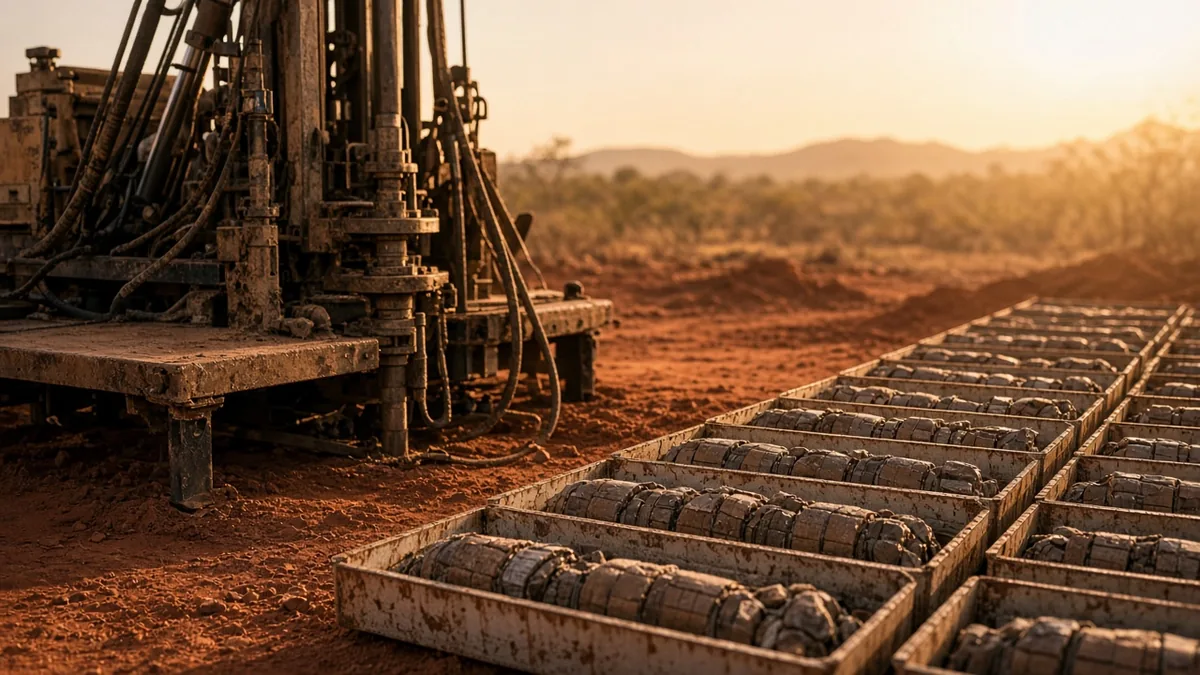
Augustus Minerals intersected a 71-metre gold zone grading 0.50 grams per tonne at its Music Well project near Leonora, Western Australia, according to SMH Business. The result landed the same session the ASX 200 climbed 1.37% to 9153, even as spot gold slipped 0.72% to $3988.50 an ounce, according to WealthWatchPro market data dated 11 November 2026.
A Scissor Hole Confirms the Geological Model
The headline intercept at the Clifton East prospect came from the first five holes of a reverse-circulation campaign, with the 71-metre zone starting from just 15 metres downhole and containing a higher-grade core of 13m at 1.05g/t gold from 22m. The hole was drilled in the opposite direction to an earlier strong result of 34m at 0.83g/t gold, a deliberate scissor hole designed to test whether the mineralisation held its width and grade from the reverse angle. It did, staying within the gold-bearing zone for its entire length.
Augustus Minerals general manager exploration Andrew Ford said the result confirmed the mineralisation dips moderately to the northwest, giving the company a clear direction for follow-up drilling across a 540m by 240m target area. Two holes drilled 80m to the northeast returned lower grades, consistent with running parallel to the mineralised lodes rather than crossing them, a useful negative that sharpens the geological model rather than undermining it.
Drilling in the opposite direction to earlier holes was an important test at Clifton East. The latest hole was drilled near the strong intersection in the earlier hole and stayed within the gold-bearing zone for 71m. This highlights the down-dip continuity of the mineralisation and shows it dips to the northwest, which gives us a clear direction for the next phase of drilling.
The rig has already moved to the St Patrick's Well prospect, where earlier rock-chip sampling returned assays of 30.4g/t, 21.7g/t and 20.4g/t gold along a 600-metre strike, sitting on the same shear zone that hosts the Clifton East mineralisation and the nearby Celtic gold mine. Five RC holes are planned there. Multi-billion-dollar producer Gold Fields Limited holds a 5.33 per cent strategic stake in Augustus, a detail that lends institutional weight to an otherwise early-stage explorer.
Junior Gold Explorers Catch a Bid as Bullion Cools
The timing is notable. Gold fell 0.72% to $3988.50 an ounce on WealthWatchPro data from 11 November 2026, pulling back from recent highs even as silver gained 1.56% to $52.02 and copper added 0.84% to $6.29 a pound. Bullion softening while an unlisted-scale explorer generates headlines is not a contradiction. It is a feature of how capital moves inside a resources cycle. When the metal price itself stalls, speculative appetite often migrates down the risk curve, toward companies whose share price is driven by drill results rather than the gold price alone.
That migration shows up elsewhere in the data. The VIX fell 9.97% to 17.52, and the Russell 2000 gained 0.99%, both consistent with a risk-on tilt toward smaller, higher-beta names. The ASX 200's 1.37% advance to 9153 outpaced several developed market peers on the same day, including the FTSE 100's 0.78% gain and the Dow's 0.48% rise, suggesting Australian equities, with their heavy resources weighting, are absorbing this rotation more directly than US or UK benchmarks.
Sector Rotation and the Market Structure Signal
WealthWatchPro analysis reads this as a market structure signal rather than a one-off. With the Shiller CAPE ratio sitting at 39.7, large-cap equity valuations remain stretched by historical standards. Capital searching for asymmetric payoffs, where a single drill result can move a share price by double digits, naturally gravitates toward the junior exploration end of the market when blue-chip multiples look full. The Music Well result fits that pattern: a company with a 1242 square-kilometre land package in a district holding more than 28 million ounces of reported gold endowment, sitting beside Northern Star's Darlot and Thunderbox operations and Genesis Minerals' King of the Hills mine, offers exactly the kind of leveraged exposure that risk-on rotation favours.
This is the same dynamic that has inflated and deflated speculative pockets of the market across market cycles, and readers can explore the parallels in more depth via Bubblepedia's historical analysis of resource-sector speculation. Sector rotation of this kind rarely announces itself with a single data point. It shows up as a cluster: a falling VIX, a rising small-cap index, and a headline-grabbing drill result landing on a day the broader index rallies.
Background: Where the ASX 200 Fits
The ASX 200 carries one of the heaviest resources weightings of any major developed-market index, which is part of why days like this move the Australian benchmark more than its global peers. Readers unfamiliar with how the index is constructed and weighted can review ASX 200 Explained for background. The broader mechanics of how capital shifts between large-cap defensives and small-cap cyclicals over a cycle are covered in Sector Rotation, and investors assessing whether a drill-result rally reflects genuine momentum or short-term noise may find Technical Analysis Basics useful as a companion framework.
Risks and What Comes Next
Augustus still faces real uncertainty. Its application over the 2.5 million ounce Mt Kare gold-silver project in Papua New Guinea is contested, with the company currently second in line and the PNG government holding final discretion over technical capacity, financial strength, landowner consent and environmental compliance. Executive chairman Brian Rodan's prior role as managing director of ACM PNG during the project's 2012-13 stage-one drilling adds relevant experience, but does not guarantee the outcome. At Music Well itself, the current results remain exploration-stage: wide intercepts at modest grades need higher-grade shoot definition before they translate into a resource that supports development economics.
Investors should treat the Clifton East and St Patrick's Well results as confirmation of a promising geological model, not as a production outcome. The pattern of risk appetite moving toward small-cap resource names while gold itself softens is worth monitoring into the next reporting cycle, particularly if the VIX continues its retreat from current levels near 17.52.
This is general information only and not financial advice.