The Home Investor's Toolkit — Setting Up a Professional Investment Office at Home
Establishing a professional home investment office involves building a workspace and digital infrastructure designed to facilitate disciplined financial analysis, performance tracking, and regulatory compliance.
Key Takeaways
- →Dedicate a quiet, separate room with dual monitors, ergonomic furniture, and reliable high-speed internet for focused investment analysis.
- →Install portfolio management software, spreadsheet templates, and secure cloud storage for tracking performance and maintaining investment records.
- →Establish systematic filing for tax documents, brokerage statements, and research reports to ensure ATO compliance and audit readiness.
- →Create daily market review routines, weekly portfolio assessments, and monthly performance reports to maintain investment discipline and objectivity.
- →Budget $3,000-$8,000 for professional setup including technology, furniture, software subscriptions, and data feeds for serious investing.
Spreadsheet vs Calculator
Financial calculators compute bond yields and NPV 10x faster than spreadsheets for standard problems
Document Retention
ATO requires investment records kept for 5 years after the relevant tax return
HP 12C Heritage
The HP 12C has been the standard financial calculator for professionals since 1981
Record Keeping Cost
Poor record keeping can cost thousands in missed deductions and CGT errors
Secure Storage
Investment documents, share certificates, and tax records should be stored in fireproof containers
Home Office Deduction
A dedicated home investment workspace may be partially tax deductible — consult an adviser
Transitioning from a casual hobbyist to a serious, self-directed investor involves a significant shift in mindset and methodology. Beyond developing a sound investment philosophy, this evolution requires establishing a professional-grade home office environment. A well-structured workspace, equipped with the right physical and digital tools, is not a luxury but a fundamental component of effective capital management. It facilitates disciplined analysis, streamlines administrative tasks, and ensures rigorous compliance with regulatory obligations, forming the operational bedrock upon which successful long-term investment strategies are built.
The absence of an organised system can be costly. Inefficiencies in tracking performance or accessing information can lead to suboptimal decisions, while poor record keeping can result in significant financial penalties from the Australian Taxation Office (ATO) or the overpayment of Capital Gains Tax (CGT). By systematically assembling a toolkit of calculators, software, and storage solutions, the home investor can create an environment that rivals a professional fund manager's office in its efficiency and rigour. This setup empowers the investor to move beyond passive participation and take active, analytical control of their financial future.
The Foundational Tools: Hardware and Software
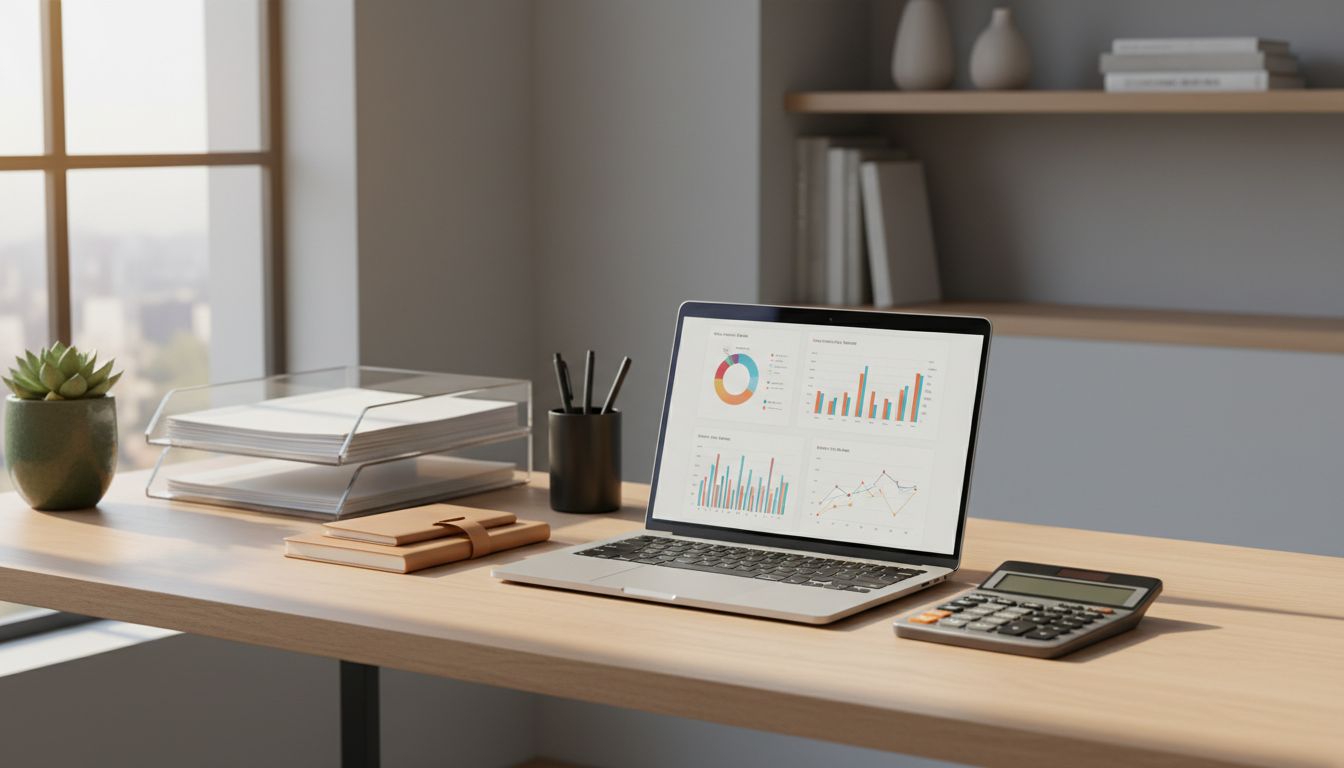
The cornerstone of a home investment office is a dedicated, distraction-free workspace. While it is tempting to manage a portfolio from the kitchen table, a designated desk and ergonomic chair promote the focus required for deep analytical work, such as reviewing company annual reports or assessing macroeconomic data. This physical separation helps create a mental boundary between daily life and the serious business of managing wealth. Furthermore, establishing a dedicated home office used exclusively for generating investment income may allow for certain running expenses to be claimed as a tax deduction.
The rules surrounding this are complex, so it is essential to consult with a qualified tax adviser to understand your specific entitlements and obligations.
On the digital front, a suite of essential software forms the core of the investor's toolkit. At the most basic level, a powerful spreadsheet program such as Microsoft Excel or Google Sheets is indispensable. It serves as a flexible platform for portfolio tracking, performance calculation, and basic financial modelling. This should be complemented by a secure cloud storage service (e.g., Google Drive, Dropbox, or Microsoft OneDrive) for housing digital copies of all investment-related documents.
Implementing two-factor authentication on these services is critical for protecting sensitive financial data. While spreadsheets are versatile, many investors also find value in specialised portfolio tracking software that can aggregate data from multiple brokerage accounts and provide more sophisticated performance and risk analytics.
The Financial Calculator: An Investor's Essential
While spreadsheets are powerful, for many core financial calculations, a dedicated financial calculator remains a superior tool. Tasks such as calculating a bond's yield to maturity, determining the net present value (NPV) of a project's cash flows, or solving for loan amortisations can be performed with far greater speed and fewer errors on a purpose-built device. For common problems, a proficient user can often find an answer on a financial calculator up to ten times faster than by building and debugging a formula in a spreadsheet.
This speed allows an investor to rapidly compare multiple scenarios or screen a list of potential investments, making it an indispensable part of the analytical process.
Two models have dominated the professional finance landscape for decades. The HP 12C, first released in 1981, is an icon in the industry, particularly in real estate and fixed-income circles. Its defining feature is the use of Reverse Polish Notation (RPN), an efficient, stack-based data entry system that eliminates the need for parentheses in complex calculations. Once mastered, RPN allows for rapid, sequential computations, making it ideal for the multi-step valuations common in property and bond analysis.
For investors focused on assets with predictable cash flows, such as those explored in our guide to bonds-explained, the HP 12C remains a benchmark for professional efficiency.
The primary alternative is the Texas Instruments BA II Plus. This calculator is the preferred choice for those pursuing the prestigious Chartered Financial Analyst (CFA) designation. It uses a standard algebraic operating system, which is immediately familiar to anyone who has used a standard scientific calculator. Its worksheet functions are particularly well-suited to corporate finance and equity valuation problems, such as analysing cash flows and performing discounted cash flow (DCF) analysis. For investors who spend significant time reading financial statements and valuing individual companies, the worksheet-driven approach of the BA II Plus often provides a more intuitive workflow.
Building Your Portfolio Tracking System
The annual statements and online dashboards provided by brokerage platforms are a useful starting point, but they are insufficient for serious portfolio management. These platforms typically only show data for the assets held within that specific account, offering a fragmented view for investors who use multiple brokers, hold direct property, or have a Self-Managed Super Fund (SMSF). A consolidated, personal tracking system is the only way to gain a true, holistic understanding of your entire asset allocation, overall performance, and tax liabilities across all entities. This master view is critical for effective portfolio rebalancing and strategic decision-making.
A custom-built spreadsheet is the most common and flexible solution. The core of this tracker should be a transaction ledger that captures every single purchase and sale. Essential columns include: Asset Ticker/Name, Transaction Type (Buy/Sell), Date, Quantity, Price per Unit, and Brokerage Fees. From this ledger, you can create a portfolio summary sheet that lists each current holding and calculates its value. Crucially, your spreadsheet must include a column for the cost base of each parcel of shares.
The cost base is not just the purchase price; under Australian tax law, it includes incidental costs like brokerage fees. Meticulously tracking the cost base for each purchase is the only way to accurately calculate your Capital Gains Tax (CGT) when you eventually sell the asset. Failure to do so often leads to significant overpayment of tax.
The complexity of modern portfolios can sometimes exceed the practical limits of a manual spreadsheet. This is particularly true for investors in cryptocurrencies. The high volume of transactions, airdrops, staking rewards, and transfers between wallets makes manual cost base tracking nearly impossible. In this context, specialised crypto-tax software becomes an essential part of the toolkit. Services like Koinly, CoinLedger, and CryptoTaxCalculator integrate directly with exchanges and blockchains via APIs to automatically download transaction histories.
They then apply the ATO-approved accounting methods (like 'First-In, First-Out') to calculate the cost base and capital gain or loss for every single taxable event, generating reports ready for your tax return.
Mastering Record Keeping for ATO Compliance
For the serious investor, meticulous record keeping is not a discretionary task; it is a legal obligation. The Australian Taxation Office (ATO) mandates that all records related to earning investment income must be retained for a specific period. The general rule is that you must keep these records for five years from the date you lodge the tax return in which the income or capital gain was declared. This long retention period underscores the importance of a systematic and durable storage solution, as records from a share purchase made today might be needed for a tax assessment many years in the future.
Poor record keeping is a primary cause of audit adjustments and can cost investors thousands in avoidable tax and penalties.
An investment "record" is a broad category that includes more than just buy and sell confirmations. It encompasses any document that substantiates a figure on your tax return. This includes CHESS holding statements, buy and sell contract notes from your broker, all dividend and distribution statements (including the annual tax summary), records of any interest paid on investment loans, and invoices for expenses such as investment advice, management fees, or subscriptions to financial data services.
For example, failing to keep a record of a $500 subscription to a financial data service means forfeiting the tax deduction on that expense, costing a mid-career investor on a 32.5% marginal tax rate over $160 in overpaid tax.
The most effective organisational system is often the simplest. Create a digital folder structure organised by financial year (e.g., '2024-2025', '2025-2026'). Within each yearly folder, create subfolders for key categories: 'Brokerage Contract Notes', 'Dividend Statements', 'Tax Statements (Annual)', 'Investment Property Income & Expenses', and 'Other Investment Expenses'. As documents are received, scan paper records into PDF format and save them with descriptive filenames immediately. This 'do it now' principle prevents the buildup of a chaotic backlog at tax time.
While the ATO accepts electronic copies of records, retaining the original paper documents for high-value items like share purchase contract notes provides a robust backup against data loss.
Secure Storage for Critical Physical Documents
Despite the dominance of digital systems, certain physical documents related to your investments must be retained and protected. These include original property titles, signed legal contracts, original wills, share certificates from off-market transactions, and pre-CHESS share certificates. The loss of such documents through fire, flood, or theft can be financially catastrophic, sometimes requiring lengthy and expensive legal processes to replace. Therefore, secure physical storage is a non-negotiable component of a professional home investment office.
The recommended solution is a high-quality, fire-rated, and waterproof document safe. A purpose-built safe like the SentrySafe Fireproof Document Box provides robust protection against the most common household disasters and is rated to protect paper documents at temperatures up to 843°C (1550°F) for 30 minutes. Investing in such a safe is a small, one-off cost relative to the immense value of the assets it protects.
The safe should be located in a discreet but accessible part of the home, and a trusted person, such as a partner or executor, should know where to find the key or combination.
For ultimate security, a bank safe deposit box remains a valid alternative, though it lacks the immediate accessibility of a home safe.
Putting It All Together: A Workflow for Success
An effective home investor's toolkit is more than the sum of its parts; it is an integrated workflow. The process begins with a transaction: a buy or sell order is placed via your brokerage platform. Immediately upon execution, the contract note is downloaded and saved into the appropriate financial year folder in your cloud storage. Concurrently, the transaction details are entered into your master tracking spreadsheet. This single action ensures both your tax records and your performance tracking are always up-to-date.
This workflow extends to corporate actions and income distributions. As dividend statements arrive, they are saved digitally and the income amounts (including franking credits) are logged in your spreadsheet. Periodically, perhaps quarterly, you can use this updated data, in conjunction with your financial calculator, to assess your portfolio's performance, calculate your asset allocation drift, and determine if any rebalancing is required. By annually reviewing your records, you ensure compliance and prepare for a smooth tax season.
For investors looking to deepen their analytical capabilities and find new tools to integrate into this workflow, exploring our investor tools page is an excellent next step.
Key Takeaways
- A dedicated home office, both physical and digital, is the foundation for disciplined and professional self-directed investing.
- The HP 12C (using RPN) is a benchmark for property and bond analysis, while the Texas Instruments BA II Plus is preferred for corporate finance and CFA-style equity valuation.
- A custom-built portfolio tracking spreadsheet is essential for a holistic view of performance and, critically, for accurately tracking the cost base for Capital Gains Tax (CGT).
- The ATO requires investment records to be kept for five years; a structured digital filing system organised by financial year is the most efficient way to ensure compliance.
- Critical physical documents like property titles and original certificates must be stored in a high-quality, fireproof, and waterproof safe to protect against catastrophic loss.
- Integrating these tools into a consistent post-trade workflow—saving documents and updating spreadsheets immediately—prevents administrative backlogs and ensures data accuracy.
Frequently Asked Questions
What equipment do I need to set up a home investment office in Australia?
Essential equipment includes a reliable computer with dual monitors, high-speed internet, dedicated phone line, scanner for ATO documents, backup storage, and ergonomic furniture. Consider ASX-approved trading platforms, portfolio management software, and a separate workspace to maintain professional boundaries and potentially claim tax deductions for your home office expenses.
Can I claim tax deductions for my home investment office with the ATO?
Yes, the ATO allows home office deductions for investment activities if the space is used exclusively or primarily for managing your portfolio. You can claim equipment depreciation, utilities, internet costs, and furniture using either the fixed rate method (67 cents per hour) or actual cost method, provided you maintain detailed records.
What records must I keep for ASIC and ATO compliance in my home office?
Maintain transaction records, dividend statements, capital gains/losses documentation, research notes, and correspondence for at least five years. Digital storage with cloud backup is recommended. Keep separate files for each financial year, investment property records, and foreign investment notifications required by the ATO and FIRB where applicable.
How do I monitor Australian market performance from my home office setup?
Use ASX-approved data feeds, financial news platforms like Bloomberg or Refinitiv, and portfolio tracking software. Set up real-time alerts for ASX announcements, RBA interest rate decisions, and company reports. Consider subscription services for Australian market research and ensure your internet connection supports live trading if actively managing positions.
Recommended

Key Statistics
Spreadsheet vs Calculator
Financial calculators compute bond yields and NPV 10x faster than spreadsheets for standard problems
Document Retention
ATO requires investment records kept for 5 years after the relevant tax return
HP 12C Heritage
The HP 12C has been the standard financial calculator for professionals since 1981
Record Keeping Cost
Poor record keeping can cost thousands in missed deductions and CGT errors
Secure Storage
Investment documents, share certificates, and tax records should be stored in fireproof containers
Home Office Deduction
A dedicated home investment workspace may be partially tax deductible — consult an adviser