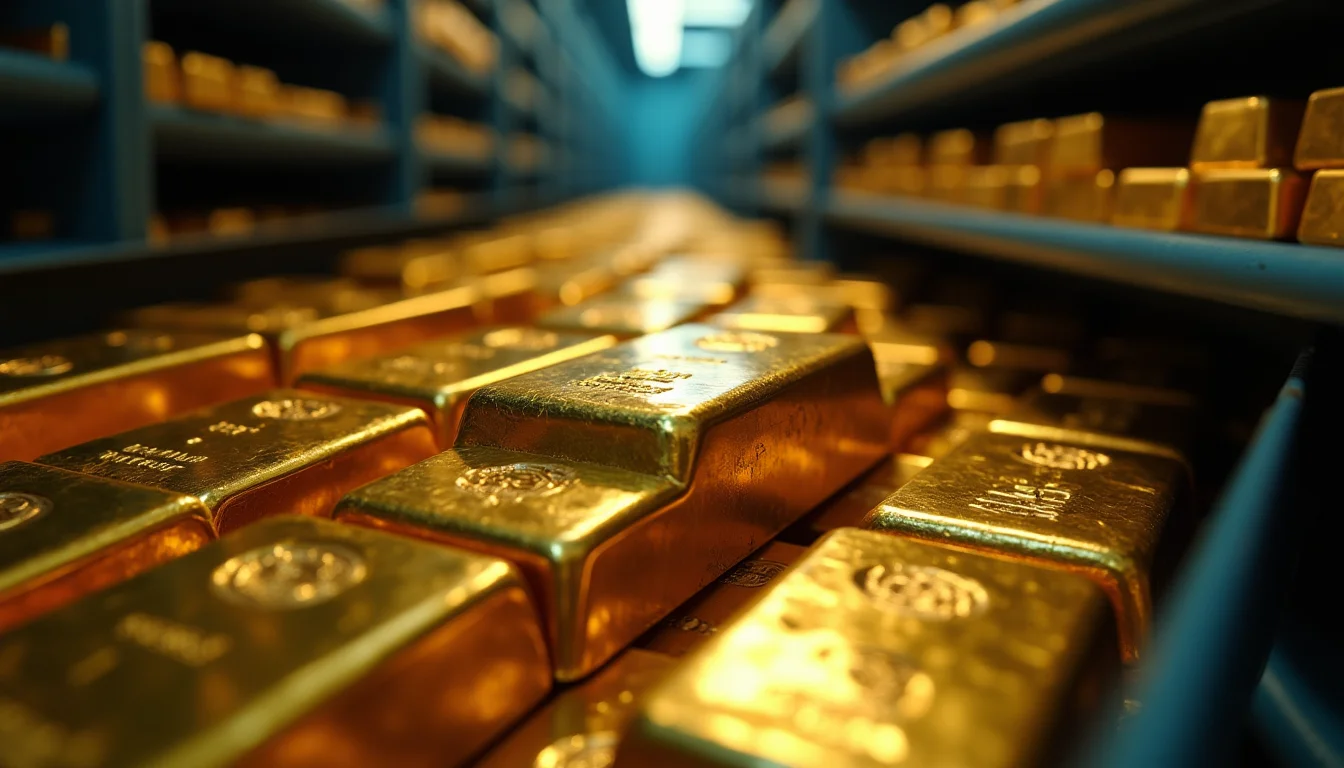
Gold trades at $4,187.15 an ounce, up 0.15% on the day, while silver has climbed 2.73% to $61.05. According to The New York Times, Donald Trump has announced a White House inquiry into Federal Reserve Governor Lisa Cook. The Financial Times confirms Trump has formed a committee specifically tasked with investigating the sitting governor.
A Direct Challenge to Fed Independence
The Federal Reserve's credibility rests on the perception that monetary policy decisions sit outside political reach. A White House-led inquiry into a sitting governor cuts against that separation. Markets have historically treated threats to central bank independence as a reason to hold hard assets rather than currency exposed to political interference.
The Fed Funds Rate sits at 3.75%, with the US 10-year Treasury yield at 5.22%. That gap between short and long rates already signals investor unease about the path of US fiscal and monetary policy. An inquiry targeting a Fed governor adds a layer of institutional uncertainty on top of that rate structure, and institutional uncertainty is precisely the condition under which gold tends to outperform cash and bonds.
Why Central Banks Are Watching Gold Flows
Central banks have been net buyers of gold for several years, a trend tied directly to concerns about currency and reserve concentration. A domestic political dispute over Fed leadership reinforces the logic behind that buying. If the institution setting US monetary policy faces a credibility challenge, reserve managers elsewhere have less reason to concentrate holdings in US dollar assets alone.
Platinum is up 3.12% to $1,693 and palladium has gained 2.22% to $1,150. The breadth of the move across the metals complex, not just gold and silver, suggests the rally reflects more than a single news cycle. It points to a broader repricing of institutional risk across precious metals as an asset class.
A White House committee investigating a sitting Federal Reserve governor is the kind of event that reserve managers and central bank gold buyers treat as a structural signal, not a one-day headline.
Trust in Financial Institutions Under Pressure
The timing is notable alongside a separate development reported by the BBC, which confirmed a former Deutsche Bank trader jailed for rigging interest rates has had his conviction overturned. Taken together, these stories highlight a recurring theme in financial markets: confidence in the institutions that set and police benchmark rates is never permanent. Each episode, whether a rigging conviction reversed years later or a political inquiry into a central bank governor, chips away at the assumption that rate-setting mechanisms operate free of distortion.
This is the exact environment in which gold has historically found demand. When the mechanisms underpinning currency and rate policy face scrutiny, investors look for an asset with no counterparty and no dependence on institutional trust. For a deeper look at this dynamic and how it has played out across market cycles, readers can consult Bubblepedia's analysis of historical gold cycles, which traces how political and institutional stress has repeatedly preceded sustained gold demand.
Background: Gold's Role When Institutions Face Scrutiny
Gold's function as a safe haven is not new, but the specific trigger matters. A detailed explanation of why investors turn to gold during periods of institutional or policy uncertainty is available at Gold as a Safe Haven Asset, which covers the historical pattern of gold performance during currency and credibility crises. Investors weighing gold against other inflation hedges may also find Gold vs Bitcoin: Store of Value Comparison useful, particularly with Bitcoin trading at $82,819, up 0.45% on the day, as a parallel but distinct hedge narrative.
What the Broader Market Is Pricing
Risk appetite elsewhere remains firm. The S&P 500 sits at 7,811.54, the VIX has fallen 3.7% to 14.84, and the composite sentiment reading stands at 76, described as Risk-On. That combination, equities near highs with volatility low, alongside a precious metals complex moving higher in unison, is unusual. It suggests investors are not fleeing risk assets broadly. Instead, they appear to be adding gold, silver, platinum and palladium as a specific hedge against institutional and political risk tied to the Fed, rather than against a broader economic downturn.
US inflation sits at 2.6%, near target, which removes the standard inflation-hedge explanation for the metals move. That reinforces the reading that the Lisa Cook inquiry, not inflation data, is the proximate driver of the current bid under gold and silver.
The Path Ahead
Investors with exposure to US dollar assets should treat the Cook inquiry as a signal worth monitoring beyond its immediate news cycle, watching for any follow-through in central bank reserve allocation data over coming quarters.