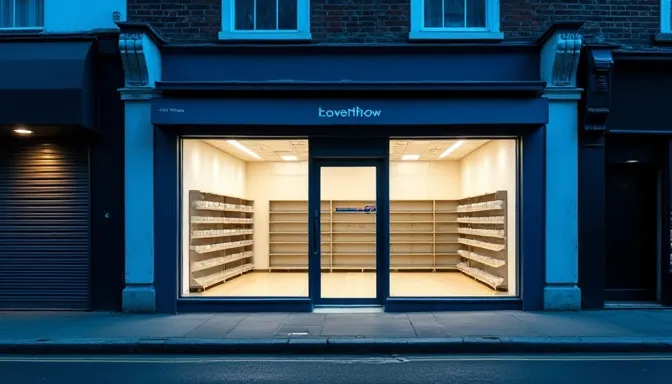
Poundland's board filed a notice of intention to appoint administrators this week, starting a 10-day countdown to find a rescue buyer for the 800-store discount chain, according to BBC News. Gordon Brothers, the US investment firm that bought the Walsall-based retailer for just £1, a sum Pepco described as nominal, according to BBC News, in 2025, has cut off funding and rejected a takeover offer from Irish firm Martin Property Group.
From a Wolverhampton Market Stall to an 800-Store Chain
Poundland's founder Steve Smith grew up around his parents' market stall from the age of two. With a £50,000 loan from his parents, he opened the first Poundland shop in The Octagon Shopping Centre in Burton-upon-Trent, Staffordshire, on 13 December 1990. That first day, selling 624 products at a single price point, the store took more than £13,000, according to BBC News.
Smith and his wife Tracy owned the business for 16 years before he sold his remaining shares in 2006 for £250m. The brand passed through Polish owner Pepco before being sold again in 2025 to Gordon Brothers for a figure Pepco itself described as nominal. At that point Poundland employed around 16,000 staff across more than 800 UK and Ireland stores. The arc from a £50,000 family loan to a £250m exit, then to a near-zero valuation sale within two decades, is the clearest marker of how far the underlying economics of the business shifted.
Private Equity Ownership and the Funding Cutoff
The immediate trigger for administration is a financing decision, not a single bad trading quarter. Gordon Brothers withdrew funding support and turned down the Martin Property Group bid, according to BBC News, leaving the Poundland board to state it had run a formal sale process and received offers covering only parts of the business. The board said several established retail operators had made formal offers that collectively cover a significant part of the operation, which it believes offers the best available prospect for creditors and jobs.
This is a familiar pattern in leveraged retail ownership. A financial sponsor acquires a distressed consumer brand at a steep discount, attempts to stabilise cash flow, and then withdraws support when the turnaround timeline extends past the sponsor's risk tolerance. Staff at the company's Walsall headquarters protested this week, underscoring the human cost that sits behind the balance sheet decision.
The real problem for Poundland is, when they first started it was really great because everything was £1, that was a really unique selling point for them, according to Professor Sarah Montano, a retail expert at the University of Birmingham.
Sector Rotation Within Discount Retail
Montano's broader point, reported by BBC News, is that rivals have closed the pricing gap and, in many product categories, now undercut Poundland outright. A single-price model built in 1990 around the novelty of £1 goods loses its edge once competitors offer similar baskets at lower average prices. This is sector rotation at the business-model level: capital and customer loyalty moving from a first-mover discount format toward newer entrants that compete on category-specific pricing rather than a fixed price point.
The same dynamic shows up in equity markets at a macro level. When a sector's defining advantage erodes, capital does not wait for the full story to play out. It reallocates. WealthWatchPro's reading of this quarter's trading is that investors are already pricing structural risk into cyclical retail more broadly, distinct from the single-stock story of Poundland.
What This Means for Equity Market Structure Right Now
Poundland's crisis lands on a volatile trading day. WealthWatchPro market data for October 31, 2026 shows the VIX at 19.42, up 12.91% on the session, while the S&P 500 fell 1.82% to 7,580.07 and the Nasdaq 100 dropped 3.46% to 28,384.85. The Russell 2000, a proxy for smaller and more domestically exposed companies including retailers, fell 1.66% to 2,811.84. The FTSE 100, by contrast, edged up 0.07% to 10,729.78, with GBP/USD firmer at 1.3389.
That divergence matters for sector rotation analysis. A rising VIX alongside falls concentrated in small-cap and growth-heavy indices typically signals capital moving toward perceived safety rather than away from equities altogether. Retail names carrying private equity debt structures, thin margins, and exposure to a cost-of-living squeeze sit at the sharp end of that rotation. Poundland's funding withdrawal is a company-specific event, but it occurs inside a market environment where the Shiller CAPE ratio stands at 40.13, a level that leaves little room for weak balance sheets to absorb shocks. For a deeper look at how leveraged buyout structures reshaped retail and consumer sectors after the financial crisis, see WealthWatchPro's history of stock markets, part three: the GFC, the decade of QE, and the modern market.
Investors assessing retail sector exposure during this kind of rotation should weigh balance sheet leverage as heavily as same-store sales growth. A broader examination of how speculative valuation cycles form and unwind across sectors is available at Bubblepedia's analysis of historical market bubble parallels, which offers useful context for retail names trading on legacy brand value rather than current unit economics.
Background: Ownership Structures and Shareholder Income
Poundland's journey from founder-owned business to private equity asset to administration candidate illustrates a structural difference from listed dividend-paying retailers. Shareholders in Australian-listed retail companies, for instance, often rely on franking credits attached to fully taxed dividends as part of total return, a mechanism unavailable to a privately held UK chain funded through sponsor debt rather than public equity. The contrast highlights why ownership structure, not just sector, shapes downside risk for investors.
Poundland's board has said the sale process attracted several established retail operators with formal offers covering significant parts of the business. Whether any of those offers converts into a binding rescue within the 10-day window will determine if 16,000 jobs and 800 stores survive in current form, or if a 36-year high street brand is broken up and sold in pieces.
Investors tracking UK consumer and retail equities should treat Poundland's administration filing as a live case study in how quickly a funding withdrawal can overtake a brand's historical scale, and should watch whether the rescue process concludes before the 10-day clock runs out. For broader context on current equity positioning, see WealthWatchPro's Equities Hub.
This is general information only and not financial advice.