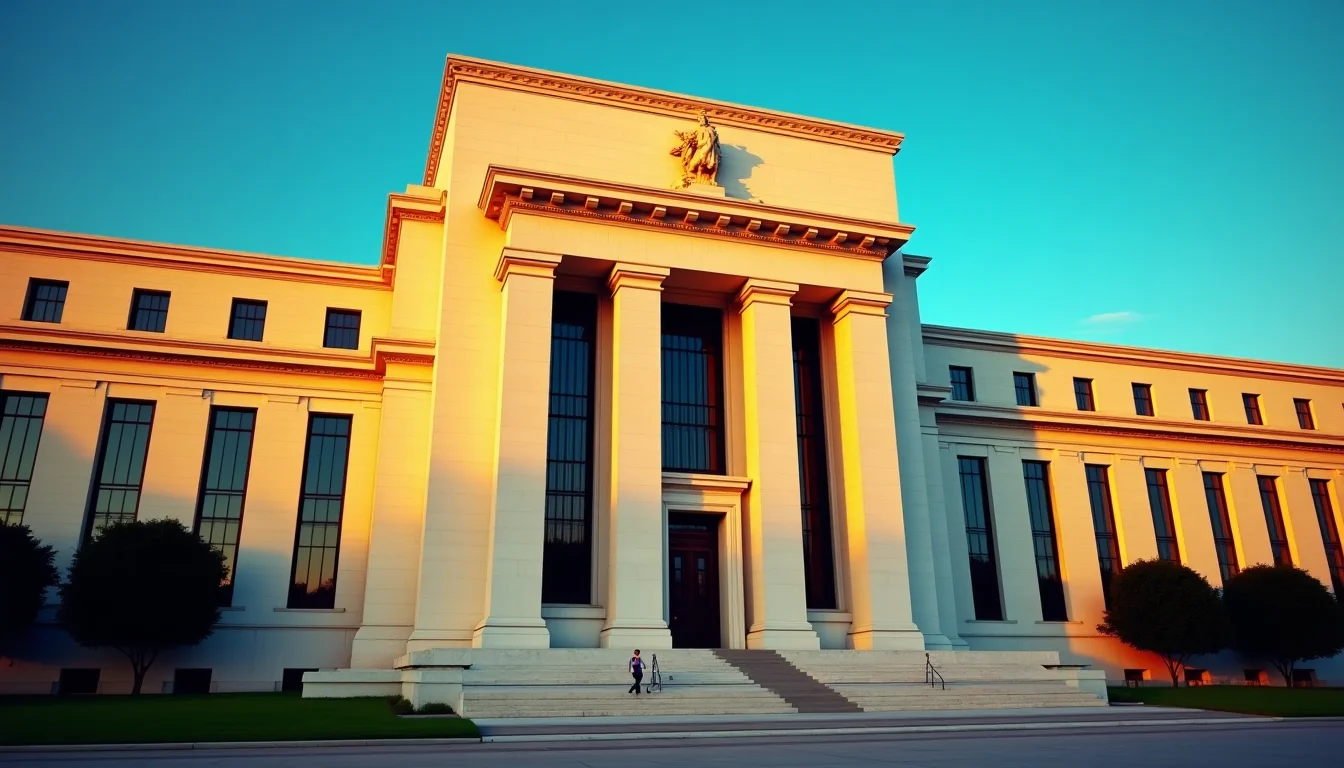
Federal Reserve officials are openly reconsidering a rate rise, according to The New York Times with US inflation holding at 2.6% and the central bank waiting on incoming data before committing to its next move. The debate within the FOMC has sharpened at a moment when the US dollar is already under pressure: EUR/USD has climbed to 1.1618, GBP/USD sits at 1.3503, and USD/JPY has dropped 1.86% to 155.71, signalling broad-based USD softness even before a formal policy pivot.
The Rate Rise Debate and What It Means for the Dollar
The NYT report makes clear that a rate increase is no longer off the table for the Federal Reserve. With the Fed Funds Rate currently sitting at 3.63% and the 10-year Treasury yield at 4.79%, the gap between short-term policy rates and long-term market rates is already wide. That compression matters for currency markets: if the Fed raises short-term rates while long-end yields remain anchored, the yield curve could steepen in a way that historically has supported USD strength, at least in the short run.
For historical context on this cycle, see CoinHours macro-crypto correlation indicators.
Yet currency markets are not behaving as if a rate rise is imminent. The EUR/USD at 1.1618 reflects a euro that has strengthened against the dollar even as the ECB Rate stands at just 2.25%, well below the Fed's effective rate. This divergence suggests that currency markets are pricing in something more than relative interest rate differentials. Confidence in the dollar's purchasing power, fiscal credibility, and the arc of the US rate cycle are all in play simultaneously.
Waller's Caution and the FOMC Split
Adding nuance to the picture, the Financial Times reported that Fed Governor Chris Waller is inclined to keep rates on hold, a position that reflects genuine caution within the committee. Waller's stance is not isolated: the Fed has historically moved in the direction of its more cautious members when data is ambiguous, and US inflation at 2.6% is close enough to the 2% target to justify patience, but not close enough to declare victory.
The split inside the FOMC creates its own market risk. When the committee is divided, forward guidance loses precision. Markets are then left to re-price rate expectations more frequently and more violently. That volatility feeds directly into the USD cycle, because currency traders rely on Fed clarity to position carry trades and hedge exposures. A Fed that might raise rates, or might hold, is harder to trade against than one with a clear signal. That ambiguity is visible in the VIX, which has pulled back to 14.94, down 1.71%, suggesting equity markets have found short-term comfort, but it does not eliminate the underlying policy uncertainty.
USD Cycle Analysis: Dollar Softness Amid Competing Forces
The broader USD picture is one of competing forces pulling in opposite directions. On one side, a potential rate rise would theoretically attract capital flows into USD-denominated assets and support the dollar. On the other side, gold at $4,475 per ounce, up 1.82%, and silver at $66.98 per ounce, up 2.32%, are both signalling that significant portions of the market are hedging against dollar erosion rather than anticipating dollar strength. Gold's rise to these levels is not simply a safe-haven bid; it reflects a structural reassessment of fiat currency purchasing power, a dynamic that has historical precedent at every major USD cycle turning point.
The USD/CNY rate at 6.7079, down 0.16%, and USD/CHF at 0.8094, down 0.38%, reinforce the picture of a dollar that is losing ground across multiple currency pairs simultaneously. Bitcoin, up 3.14% to $79,760, is also behaving in a manner consistent with dollar-hedging activity rather than pure risk appetite. When gold, silver, Bitcoin, and the Swiss franc all strengthen simultaneously against the dollar, the common factor is reduced confidence in USD stability rather than any single asset-specific catalyst. For a historical perspective on how monetary credibility shapes currency values, the History of Money: From Barter to the Gold Standard provides essential context on how fiat systems have handled similar inflection points across centuries.
When the Fed holds rates steady while inflation remains above target and long-end yields push toward 4.79%, the real cost of holding dollars falls. That dynamic, not geopolitics alone, explains why gold has risen more than 1.8% in a single session alongside broad USD weakness across G10 currency pairs.
Global Markets and the Spillover Effect
The Fed's indecision is not a domestic American problem. It is a global one. The History of Central Banking: From the Great Depression to the Age of Inflation Targeting documents how US rate cycles have consistently driven capital flows into and out of emerging and developed markets alike. The current pattern is consistent with that history: Asian equity markets are selling off, with the Hang Seng down 0.46%, the Shanghai Composite down 0.95%, and the BSE Sensex down 1.03%, while European indices are broadly flat to slightly positive. When USD direction is uncertain, emerging market and Asia-Pacific capital tends to pause or retract while investors wait for clarity.
The Nikkei 225, down 0.17%, is also notable given the USD/JPY's sharp 1.86% decline. A stronger yen compresses Japanese export earnings in yen terms, creating headwinds for Japanese equities even in a session where the BoJ rate sits at just 0.84%. This currency-equity linkage is a direct transmission mechanism of Fed policy uncertainty, one that is visible in real-time across Asian bourses. Investors looking at the broader implications of this USD volatility for speculative assets can examine the historical parallels at Bubblepedia which catalogues how currency cycles have intersected with asset price bubbles across modern financial history.
What Investors Should Watch Next
The inflation data that Fed officials are awaiting will determine whether the rate rise discussion moves from theoretical to concrete. With US inflation at 2.6%, the next CPI or PCE print carries outsized market weight. A reading that holds steady or ticks higher would strengthen the case for the rate-rise camp inside the FOMC and could trigger a rapid USD rebound, putting pressure on gold, silver, and non-dollar assets. A softer reading would reinforce Waller's hold position and likely extend the current period of dollar softness, supporting commodity prices and currency pairs that have already moved against the USD. Portfolio managers tracking cross-asset exposures should review their currency hedging positions before the next data release, because the Fed has signalled clearly that it is data-dependent rather than calendar-dependent at this juncture.