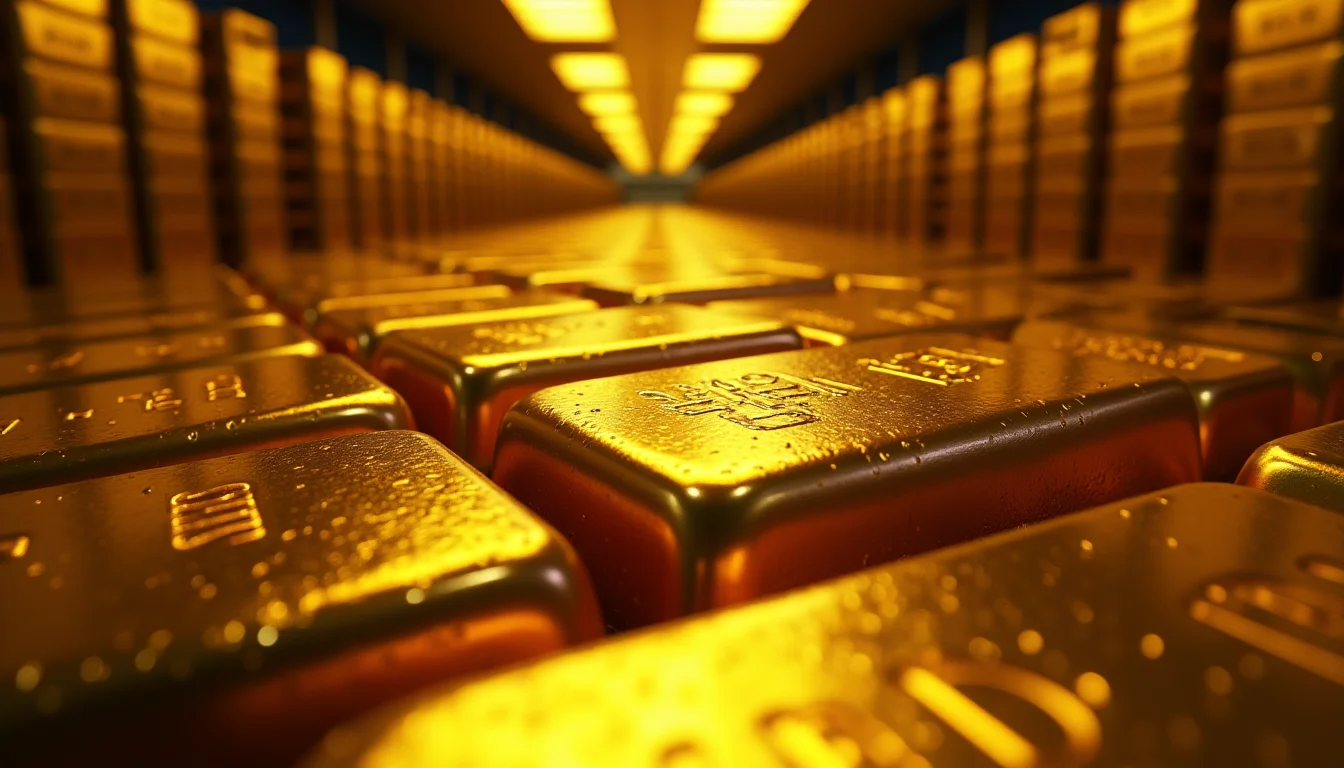
Gold climbed 0.28% to $4,027 per ounce as the New York Times reported that China's economy grew at its slowest pace in years, rattling sentiment across commodity and equity markets. The Shanghai Composite rose 1.07% and the Hang Seng gained 1.4%, suggesting domestic investors are pricing in policy stimulus rather than sustained weakness — but the macro picture for global gold demand is more complicated than a single session's equity bounce implies.
What China's Growth Slowdown Actually Means for Gold
China is the world's largest consumer of physical gold, accounting for a substantial share of global jewellery demand and a growing share of central bank accumulation. When economic growth decelerates, two forces pull in opposite directions. Consumer demand for gold jewellery typically softens as household incomes come under pressure. At the same time, institutional and government demand for gold as a reserve asset tends to firm, particularly when the domestic currency faces depreciation risk. USD/CNY currently sits at 6.7628, and any further yuan weakness would increase the domestic cost of gold imports while simultaneously making renminbi-denominated savings less attractive relative to hard assets.
The People's Bank of China has been a consistent buyer of gold reserves over recent years, a pattern mirrored by central banks across emerging markets seeking to reduce dollar dependency. A growth slowdown that pressures the yuan reinforces rather than undermines that buying rationale. For gold, the critical variable is not whether Chinese growth disappoints in any single quarter, but whether the slowdown is deep enough to trigger meaningful stimulus — stimulus that historically expands money supply and supports gold over the medium term.
EV Overcapacity and the Critical Minerals Connection
China's economic deceleration does not exist in isolation. SMH Business reports that China's EV boom has spun dangerously out of control, describing a sector characterised by overinvestment, excess capacity, and intensifying price wars. This matters for precious metals investors because the EV supply chain intersects directly with demand for platinum-group metals, copper, and silver. Platinum currently trades at $1,634 per ounce, down 0.52%, while silver — which has significant industrial demand exposure — sits at $58.35 per ounce, off 1.27%.
Central Bank Flows and the Rate Differential Context
Gold's move above $4,000 per ounce has coincided with a rate environment that remains broadly supportive of non-yielding assets, even as nominal yields stay elevated. The US 10-year Treasury yield stands at 4.62%, while the Fed Funds Rate is at 3.63% — a configuration that keeps real yields positive in the US but does not significantly penalise gold given the scale of global reserve diversification underway. The ECB rate of 2.25% and the Bank of Japan's 0.73% rate reflect materially looser monetary conditions in Europe and Japan, which traditionally support gold demand in those regions as investors seek purchasing-power protection.
Central bank gold buying has been the structural floor under prices across the past two years. When economic data from a country of China's size disappoints, the resulting uncertainty about global growth tends to reinforce institutional demand for reserve assets that carry no counterparty risk. This dynamic is captured in the historical record: periods of synchronised global growth deceleration have frequently coincided with accelerated central bank gold accumulation, as policymakers prioritise portfolio resilience over yield optimisation.
Gold at $4,027 per ounce represents a market pricing in not just current uncertainty, but a structural shift in how sovereign institutions manage reserve risk — a dynamic that Chinese growth data alone does not reverse.
Background: Physical Gold vs ETF Exposure in a Volatile Macro Environment
For investors assessing how to hold gold as China's economic outlook shifts, the choice of vehicle matters. The WealthWatchPro guide Physical Gold vs Gold ETF — Which Should You Buy? sets out the core trade-offs: physical gold eliminates counterparty risk entirely and holds value independently of the financial system, but carries storage costs and lower liquidity. Gold ETFs provide instant market access and precise position sizing, but expose the holder to fund-level risks and tax treatments that vary by jurisdiction. In an environment where central bank buying is structural and China's macro outlook is genuinely uncertain, the holding period and risk tolerance of the individual investor determine which vehicle is appropriate — there is no universal answer.
Investors seeking broader context on how precious metals fit within a diversified portfolio can refer to the Precious Metals Investing guide and the Gold as a Safe Haven Asset analysis. The Precious Metals Hub aggregates current pricing, commentary, and allocation frameworks across gold, silver, platinum, and palladium. For historical parallels on how commodity cycles interact with macro turning points, Bubblepedia's commodity cycle research provides useful context on how previous demand shocks from major economies have played out across precious metals valuations.
What Investors Should Watch Next
The Shiller CAPE at 42.0 signals that equity valuations remain stretched relative to historical norms, which historically has increased the relative appeal of gold as a portfolio hedge. The VIX at 16.41 — down 0.55% — suggests markets are not yet pricing significant near-term stress, but China's GDP miss is a data point that warrants monitoring across subsequent quarters. If Chinese stimulus measures are announced in response to the slowdown, a liquidity-driven rally in risk assets could temporarily cap gold's advance. If the slowdown deepens without a sufficient policy response, the safe-haven bid for gold is likely to strengthen. Investors holding gold as a reserve diversifier should focus on central bank demand trends and real yield movements in the US rather than short-term equity market noise as the primary signal for whether the $4,000 level becomes a durable floor or a temporary ceiling.